Technological Features of a Sentient Android Governess
In previous articles we talked about the sentient as the 'soul' of a service robot and how automation will change Crimean tourism. Today we will connect these topics at a practical level. How exactly should...

In previous articles we talked about the sentient as the “soul” of a service robot and how automation will change Crimean tourism. Today we will connect these topics at a practical level. How exactly should a robot governess look, what should it be able to do, and what are the technological limitations that we have to work around?
Why an attentive humanoid robot
The idea of a “robot governess” has been around for a long time. In Asian markets, humanoid robots are already used in nursing homes and children’s centers — they entertain, read, and help. But for Crimea, this is a specific request: a robot that can work as a hostess in a hotel, as an administrator in a museum, as an animator in a children’s center.
A humanoid form is needed not for the sake of “looking like a person”, but for the sake of interaction. A robot in human form can:
- Make eye contact (literally — the camera in the eye recognizes the direction of gaze)
- Use human gestures (nod, point, wave)
- Communicate at human height (the optimal height of the interlocutor)
- Move in spaces created for people (narrow corridors, stairs, low thresholds)
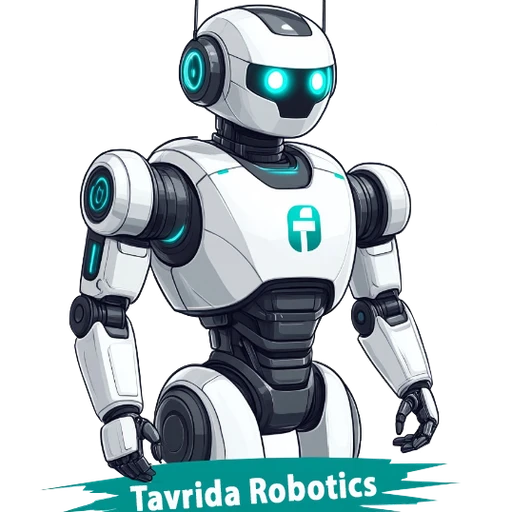
What the ServisBot V3 looks like
The third generation of our service robot, which we are preparing for release in 2027, will combine:
Mechanics:
- Height — 150 cm (average human height)
- Body — composite plastic with aluminum frame, weight — 45 kg
- Mobility — wheeled platform with differential drive, speed up to 5 km/h
- Manipulator — 6-DOF arm with pneumatic gripper (for opening doors, taking trays, etc.)
- Battery — 12 hours of autonomous operation
Sensors:
- 4K stereo cameras in the eyes (face recognition, gaze tracking)
- Depth cameras around the body (360° obstacle detection)
- Microphone array (sound source localization, speech recognition)
- Tactile sensors on hands and body (safe interaction with people)
- IMU, GPS, wheel odometry (navigation)
Sentient:
- Local neural network for emotion recognition
- 5-language speech recognition and synthesis
- Library of 200+ behavioral scenarios (hotel, museum, airport, restaurant)
- Personalization model (remembering regular guests)
What the robot can do
In a hotel:
- Meet guests at the entrance, take luggage to the room
- Tell about the hotel, the city, local attractions in 5 languages
- Take orders for breakfast, room service
- Call a live operator in case of non-standard requests
- Accompany guests to the room, the restaurant, the spa
In a museum:
- Conduct excursions according to an individual scenario
- Answer questions about exhibits
- Show additional materials on the screen
- Switch to a live guide for in-depth programs
In a children’s center:
- Conduct educational programs
- Read fairy tales
- Conduct quizzes and games
- Help with homework
Technological limitations
Honesty requires acknowledging what the robot cannot do today:
- Improvisation. The robot works according to scenarios. Non-standard situations are handed over to a live operator.
- Long dialogues. The robot supports short dialogues (3–5 exchanges), then switches to a script.
- Physical force. The robot cannot lift heavy objects (over 3 kg) or perform actions requiring fine motor skills.
- Emotions. The robot recognizes emotions but cannot feel them — this is a fundamental limitation of current AI.
What we are doing
In 2026–2027, Tavrida Robotics is launching a pilot at three Crimean hotels with the ServisBot V3. The goal is to test the robot in real conditions: hotels with different formats (resort, business, boutique), different categories of guests, different service scenarios.
If you are a hotel, museum, or children’s center — write to us via our contact form. We will discuss the pilot and prepare an individual scenario for your institution.
Disclaimer
Numerical estimates, market figures and product capabilities mentioned in this article reflect publicly available sources and the author's analytical estimates at the moment of publication. They do not constitute verified production specifications or commercial guarantees. Production characteristics are confirmed individually as part of pilot or supply agreements.
Authoritative version
The Russian-language version of this article at tavridarobotics.online//blog/robot-sentient-android-gurner/ is the primary text. This English translation is provided for convenience only; in case of any conflict, the Russian version prevails.