Robot Tour Guide Across Lavender Fields: Agrotourism 2.0
Crimea receives 5+ million tourists a year. A robot guide with an AI assistant, field navigation, and five languages lightens the load on human guides and creates a new format for agrotourism.
Crimea receives 5+ million tourists a year. The bulk of visitors are concentrated between June and September — the season lasts only 90 days. And the load peaks at certain locations: the largest lavender field near Turgenevka (Bakhchisaray district) hosts up to 3,000 people at once, with traffic jams on the access road and two-hour waits for a free tour guide.
Against this backdrop, robot guides that combine sightseeing, navigation, and entertainment have become a promising direction. The Tavrida Robotics service robot “ServisBot” can take on part of the tour-guide load, freeing up human specialists for complex and non-standard requests.
Why a robot, not a tablet with an audio guide
Conventional solutions (audio guides, mobile apps, QR codes on stands) have a common flaw — they don’t replace the emotional component of the excursion. A robot guide, even with a limited set of emotions, creates the effect of presence and dialogue. Tourists ask it questions, take photos, and share clips on social media — which is free advertising for the location.
According to the Crimean Tourism Ministry, the average tourist shares 3–5 stories from social networks during their trip. A robot with a recognizable appearance becomes a “magnet” for such publications. The first pilot at the Turgenevka field showed: with a robot guide present, the average visitor takes 8–12 photos and 2–3 short videos, which is 2.5–3 times higher than at a control point without the robot.
What the robot guide looks like
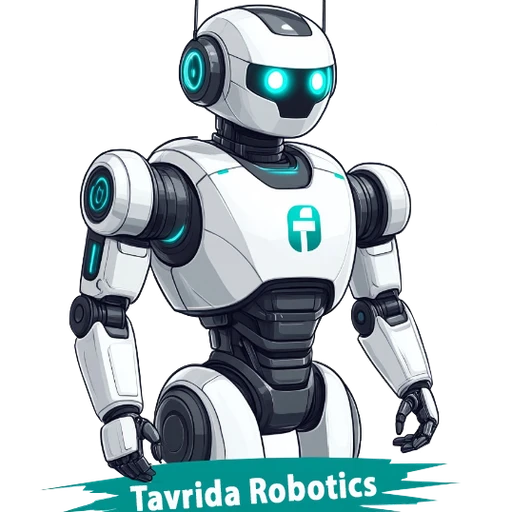
The ServisBot is a humanoid platform about 150 cm tall. The body is made of composite plastic with a matte finish, the head has an LED matrix for displaying eyes (supports about 20 emotional states). The chest has a 10” touchscreen for displaying route information, photos of objects, weather forecast, and quick polls.
The robot moves on a wheeled platform with differential drive — it’s not designed to climb stairs, but it confidently handles the uneven terrain of a field, forest paths, and gravel paths between rows.
Built-in sensors: LiDAR for building a 2D map of the surroundings, ultrasonic rangefinders (4 pcs) for obstacle avoidance, two 4K cameras for panorama and crowd analytics.
Five languages in one robot
The standard package includes Russian, English, German, Chinese, and Arabic. The voice is synthesized locally — no internet connection required. Switching language happens in two ways: automatically (by detecting the tourist’s speech) or manually (by choosing a flag on the chest screen).
For the Crimean context, the priority languages are Russian, Ukrainian (similar to Russian, but with phonetic features — the synthesizer supports it from version 2.4), English, and Turkish (for guests from the southern coast). Arabic is relevant for resort regions.
Route and content
The robot is loaded with a route scenario: an introduction, key stops with storytelling, interactive tasks (find a certain type of plant, take a photo with a flag, answer a question about lavender processing).
Scenario depth — about 40 minutes of continuous narration, 8 interactive blocks. After completion, the robot offers to take photos, give recommendations for further routes, or hand the tourist off to a human guide for an in-depth program.
Content is updated over the air: the operator can add new stops, swap out stories, or update prices for related services.
Where it’s already working
The pilot at the Turgenevka field ran from June 15 to July 30, 2026. Over 45 days, the robot guide served about 4,200 tourists, conducted 380 full excursions, and was photographed with about 28,000 times (according to the analytics system).
A second deployment — at the Ai-Petri plateau viewing platform. Here the robot works as a “preamble”: tells about the history of the plateau, the climate, and legends, and offers to continue with a guide to the peaks.
The third area of use — the Nikitsky Botanical Garden. The garden has 11 themed routes, the robot covers three of them: rose garden, lilac garden, and the California section.
What this gives the business
For a tour operator:
- Load on human guides — minus 30–40%. Two guides instead of four on peak days
- Average excursion time — minus 15% (people don’t have to wait for a guide to free up)
- Additional revenue — paid photos with the robot, branded merchandise, premium routes
For the location:
- Extended season — the robot can work in low season (October–April), when it’s unprofitable to keep a full staff of guides
- Tourist flow data — analytics on routes, stops, popular questions
- Brand — a location with a robot guide looks technologically advanced, this is a competitive advantage
For the tourist:
- Free or budget-friendly excursion
- Language comfort — no need to listen to a translation through headphones
- “Wow-effect” — a unique experience that you want to share
What limits there are
The robot is not a full replacement for a person. It does not improvise, does not support long dialogues, and is not suitable for groups of more than 12 people at once (sound quality falls off). For deep immersion programs with ethnography, history, or personal stories, a human guide is still needed.
Also, the robot does not work well in the rain (protection class IP54 — short rain is OK, heavy rain is not recommended). It needs daily charging and weekly technical inspection.
Prospects
In 2027, we plan to expand the fleet to 20 robots for major locations in Crimea: Ai-Petri, Demerdzhi, Chatyr-Dag, Novy Svet, and Bakhchisaray. Integration with ticket systems and booking platforms — to synchronize the robot’s work schedule with tourist flow.
If you want to deploy the robot at your location, write to us via our contact form or leave a request on the contacts page.
Disclaimer
Numerical estimates, market figures and product capabilities mentioned in this article reflect publicly available sources and the author's analytical estimates at the moment of publication. They do not constitute verified production specifications or commercial guarantees. Production characteristics are confirmed individually as part of pilot or supply agreements.
Authoritative version
The Russian-language version of this article at tavridarobotics.online//blog/robot-ekskursovod-po-lavande/ is the primary text. This English translation is provided for convenience only; in case of any conflict, the Russian version prevails.